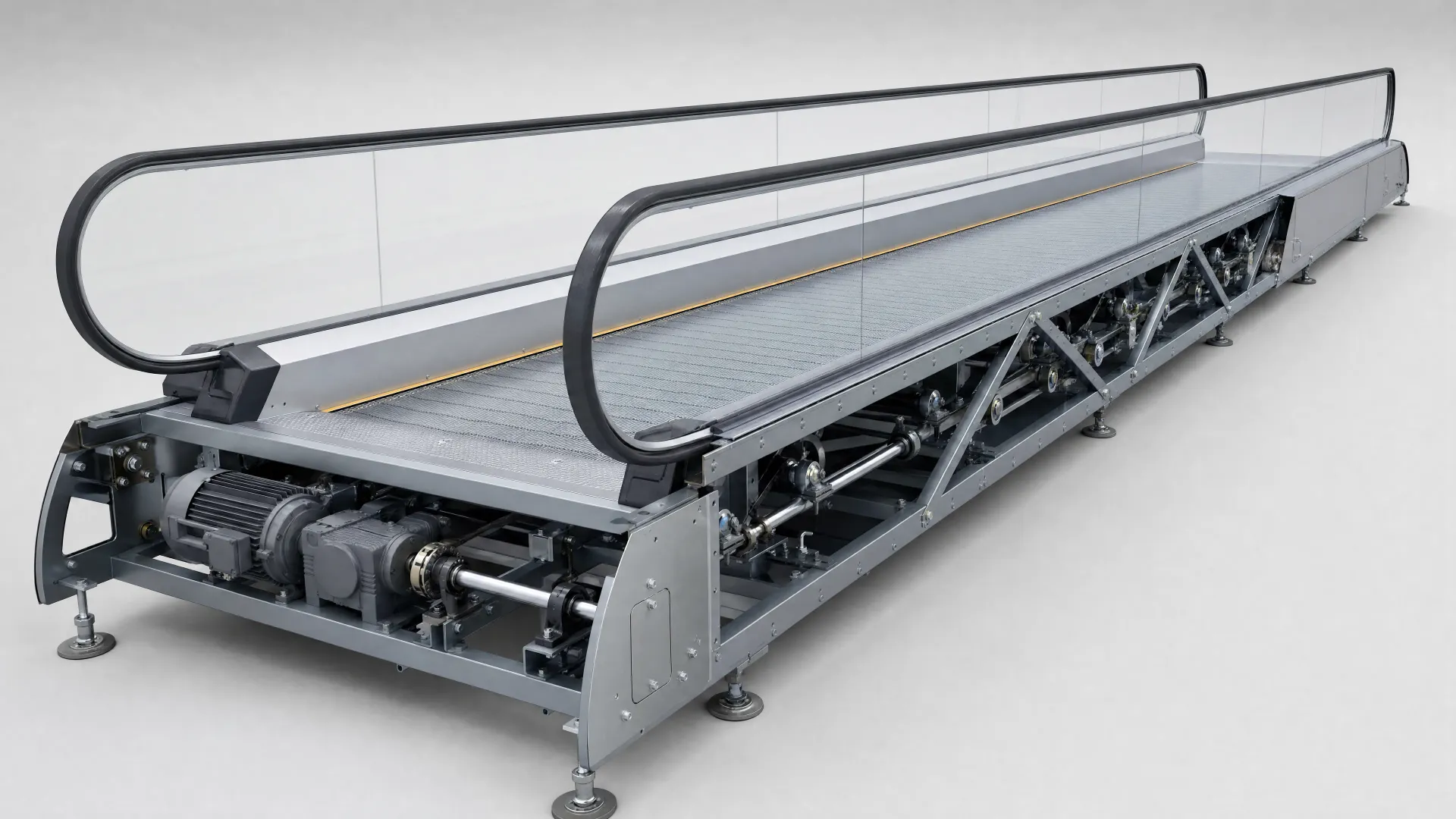
Reverse engineering & CAD reconstruction
Reverse engineering, 2D drawing conversion, 3D CAD reconstruction and STL model preparation.
What is delivered.
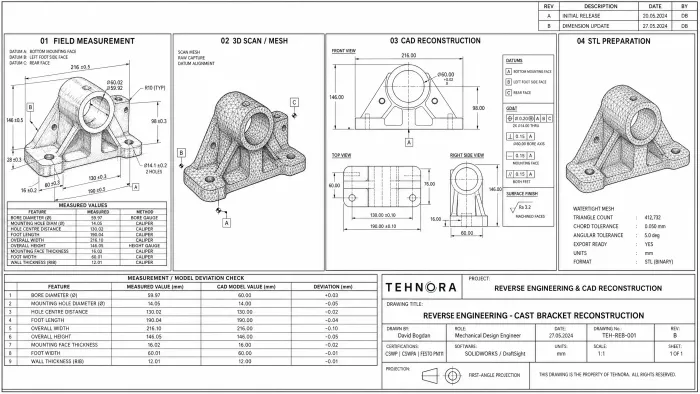
A part that exists only as hardware, a paper print or a mesh, returned as a parametric model and a current drawing set. Deviation from the original is recorded, not silently corrected.
You have the part, but no drawings.
A component is in service or in stock, the original documentation is lost or was never issued, and nothing can be quoted from it.
Your drawings exist only on paper.
Prints or legacy DWG files cannot be edited, cannot be sent to a modern supplier, and degrade every time they are copied.
The supplier no longer exists.
A part is discontinued or single-sourced, and a manufacturable definition is needed before it can be re-quoted anywhere else.
Five steps, stated inputs.
Each step names what TEHNORA needs from you, so the delivery date holds.
Required from you
The part or the files, what it has to do, and whether wear is to be reproduced or removed.
Required from you
Written confirmation of the scope and the delivery date. Countersigned NDA, if you asked for one.
Required from you
Which faces and bores are functional, so the datum scheme reflects how the part is actually located.
Required from you
Mating parts, assembly context or a fit class where a dimension has to be judged rather than measured.
Required from you
Consolidated comments per revision cycle, so the index stays readable.
| Deliverable | File format |
|---|---|
| Parametric part models | SLDPRT · STEP · IGES |
| Reconstructed assemblies | SLDASM · STEP |
| Reissued drawing sets | SLDDRW · PDF · DWG |
| Converted 2D drawings | DWG · DXF |
| Measured values and deviation table | PDF (issued on the drawing) |
| Watertight meshes for print | STL |
| Meshes for inspection comparison | STL |
| Flat patterns where sheet metal appears | DXF · DWG |
| Native files are issued at the SOLIDWORKS version agreed in the scope. Neutral formats accompany every native delivery. | |
SOLIDWORKS
Parametric reconstruction, assembly rebuilding, drawing production and STL export. Native files issued at the version agreed in the scope.
DraftSight
2D drawing conversion and legacy DWG work, where a paper print or an old file has to become an editable current drawing.
Reconstructed drawings are issued on your sheet template, title block and tolerance defaults. Where none is supplied, TEHNORA issues on its own sheet format and states the projection method and general tolerance class on every sheet. A reconstruction always starts at a new revision index rather than continuing the original's.
A reconstruction is only useful if it can be manufactured, which makes the drawing the deliverable rather than the model. CSWP is examined on exactly that, to a timed standard.
01 Who owns the IP, and is an NDA signed?
Files and parts are treated as confidential. If you want an NDA, it is signed before you send any files or parts; it can be yours, or TEHNORA issues one. Models, drawings and source data are yours on final payment; TEHNORA keeps no reuse right and no derivative library.
02 What do you need, the part or scan data?
Either. A physical sample is measured feature by feature with the instrument recorded against each value. Supplied point clouds or meshes are aligned to a datum scheme and reconstructed from there. Which route applies is fixed in the scope before work starts.
03 How close is the reconstruction to the original?
Every measured feature is compared against the finished model and the difference is issued as a deviation table with the drawings. The reconstruction is a record you can check, not an assertion.
04 Do you reproduce wear, or the part as designed?
Whichever is asked for, stated in the scope. Where measurement shows wear rather than intent, nominal dimensions are restored and the decision is noted on the drawing. The measured value stays in the table either way.
05 Can you convert old paper drawings without the part?
Yes. Prints, scans and legacy DWG are redrawn as an editable current set. Dimensions that are unreadable or contradict each other are listed for your decision rather than guessed at.
06 What are typical lead times?
It depends on how demanding the project is: the feature count and the condition of the input. The committed date is written into the quote with the fee, before work starts.
Send your drawings and request a quote.
Attach drawings, models, sketches or photographs. A written quote stating scope, fee and delivery date follows by email.
A quote stating scope, fee and delivery date follows by email.